
In Singapore, most B2B deals do not begin with an email. They begin with a WhatsApp message — and a surprising number of them end there too, without ever becoming a record anyone else in the business can see.
This is not a discipline problem, and it will not be fixed by telling your sales team to update the CRM more often. It is a structural gap between where selling happens and where selling gets recorded. Here is how to close it.
Why WhatsApp became Singapore’s default sales channel
Ask any SME sales rep where their live deals actually sit, and the honest answer is rarely “in the CRM.” It is in WhatsApp. Quotes get chased there. Appointments get confirmed there. Objections get raised and answered there, often at 9pm on a Tuesday.
This happened for a simple reason: customers reply. An email asking for a decision can sit unopened for four days. A WhatsApp message asking the same question usually gets an answer the same afternoon. Sales teams follow response rates, so the conversation moved — and it moved before anyone had a plan for what to do with the data it produced.
That is the tension. WhatsApp is now the most productive sales channel most Singapore SMEs have, and it is also the only channel that generates no records, no reporting and no institutional memory.
The real problem: WhatsApp is a black box
A CRM exists so that what one person knows becomes something the business knows. WhatsApp does the opposite. It concentrates everything on a single device belonging to a single employee.
- Nobody else can see the pipeline. A manager cannot answer basic questions — how many conversations are live, which have gone quiet, who was promised a callback this week — because the answers sit inside someone else’s phone.
- Relationships walk out with the employee. When a rep leaves, the chat history leaves too. The customer notices immediately when they are asked to re-explain something they settled two months ago.
- There is nothing to report on. Response times, follow-up rates, which conversations convert — none of it exists as data, so none of it can be improved deliberately.
What actually gets lost in the chat
It helps to be specific about what disappears, because it is never the phone number. It is the context around it.
- The quoted figure. The number given verbally, which nobody wrote down and everybody later remembers differently.
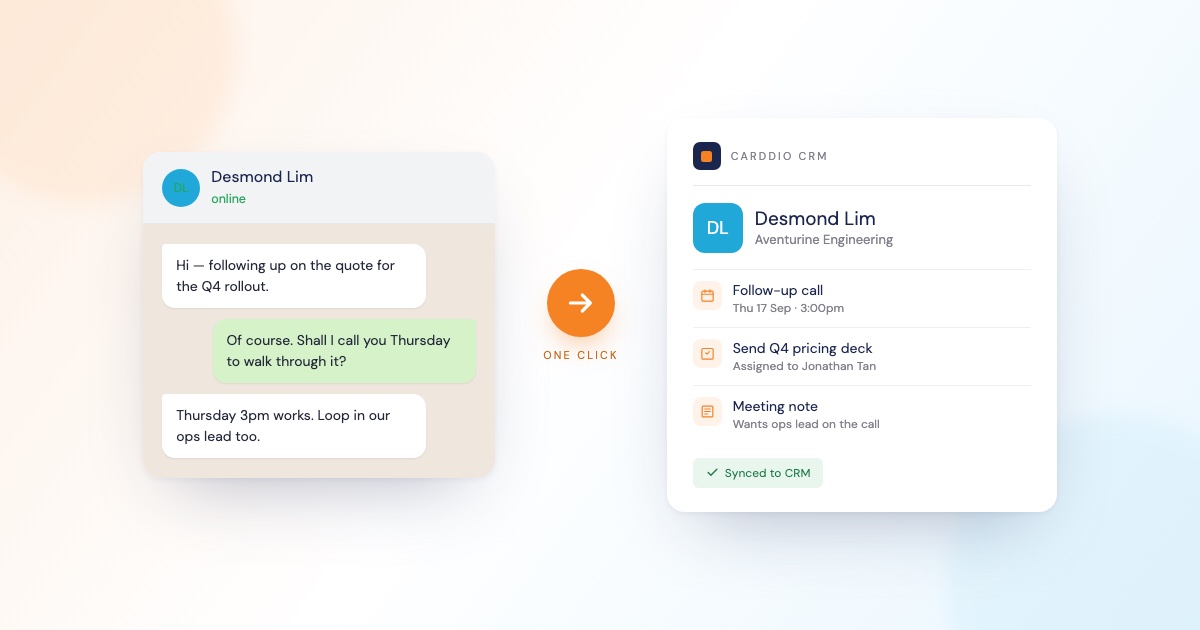
- The promised callback. “I’ll call you Thursday” is a commitment. In WhatsApp it is also a message that has scrolled out of view by Wednesday.
- The real decision-maker. The customer mentions their operations lead has to approve it. That one sentence changes your whole approach, and it is buried in a thread.
- The objection. The reason they hesitated, which your next three prospects will probably raise too, and which nobody ever aggregates.
None of this is exotic. It is the ordinary substance of a sales conversation, stored in a consumer messaging app that was never built to hold it.
Capture the contact where the conversation happens
The standard advice is “make sure your team enters WhatsApp leads into the CRM.” It does not work, and it is worth understanding why: it asks a salesperson to stop selling, switch applications, retype a name and number, and get no immediate benefit from having done so. Under pressure, that is always the task that gets dropped.
The fix is not discipline. It is removing the switch. If the contact can be created from inside the chat window, in one action, the reason for skipping it disappears — the record gets made because making it costs nothing.
That is the principle behind putting CRM functionality inside WhatsApp Web rather than alongside it. Capture has to happen at the point of conversation, not at the end of the day.
Log the context before it evaporates
Once the contact exists, the valuable part is what you attach to it. A name and number is a phone book entry. A name, number and the note “wants ops lead on the call, budget approved through Q4, worried about migration downtime” is a sales asset.
Meeting notes have a short half-life. Written within a minute of the conversation they are precise. Written at the end of the week they are vague. Written never — the most common outcome — they are gone, along with the reason the deal was winnable.
The practical test for any tool here is simple: can a rep log a note without leaving the conversation they are having? If not, it will not happen consistently, whatever the process document says.
Make the follow-up a system, not a memory
Most lost deals in SME sales are not lost to competitors. They are lost to silence. The customer was interested, the rep meant to follow up, and three weeks passed.
A follow-up that exists only as an intention is not a follow-up. It needs to be a dated record owned by a named person that appears on their list. Once a WhatsApp contact sits in your CRM, the follow-up becomes exactly that — visible to a manager, reportable, and impossible to quietly forget.
This is also where WhatsApp conversations stop being isolated chats and start behaving like a pipeline, each with a stage, an owner and a next action. Deal management only works if every live conversation is actually represented in it.
Automate the messages that repeat
A good share of sales messaging is not creative work. It is the same message sent again: the acknowledgement after an enquiry, the reminder before a meeting, the check-in after a quote goes out.
These are worth automating for two reasons. The obvious one is time. The less obvious one is consistency — an automated reminder goes out whether or not the rep is on leave, in a meeting, or simply having a bad week.
With automation triggers, a WhatsApp message can be sent based on what happens in the CRM rather than on someone remembering to send it. The judgement stays human; the repetition becomes systematic.
Use WhatsApp for campaigns, not just conversations
One-to-one messaging is where WhatsApp starts, but not where it ends. Product announcements, event invitations and seasonal promotions all behave differently on WhatsApp than in email, and for many Singapore SME audiences they perform better.
The requirement is that campaigns run on the same contact data as your sales conversations. A separate broadcast tool with its own uploaded list is how a customer ends up receiving a promotion the day after they complained about something — nobody joined the two systems together.
Running bulk WhatsApp campaigns from inside the CRM also gives you the reporting: sent, delivered, read and failed status per campaign, sitting alongside your email metrics. That turns “we sent a blast” into a number you can compare against the last one.
One contact record, whatever the channel
WhatsApp is one entry point among several. The same person might hand over a business card at a trade show, register for your seminar, then message you three weeks later. If those produce three separate records, your team has no idea it is dealing with one relationship.
The goal is that a scanned business card, an event registration and a WhatsApp conversation all resolve to the same contact with one history. That is what makes a follow-up feel informed rather than generic.
What this looks like day to day
Consider a supplier who meets a prospect at an industry event. The card is scanned on the spot and becomes a contact. Two days later the prospect messages on WhatsApp asking for pricing. The rep saves that conversation against the existing record, logs a note about the volume needed, and schedules a follow-up call for Thursday.
On Thursday the reminder appears. The rep opens the record before dialling and sees the event they met at, the volume discussed, and the fact that an operations lead has to approve. The call takes four minutes instead of fifteen, and the prospect gets the impression of a company that pays attention.
Nothing in that sequence required extra admin work. Each step was captured at the moment it happened, in the tool the rep was already using.
Frequently asked questions
No. WhatsApp is an excellent conversation channel, but it has no contact records, no pipeline stages, no follow-up scheduling and no reporting. It also keeps everything on one person’s device, so the business loses the relationship when that person leaves. The practical approach is to keep selling on WhatsApp and connect it to a CRM that stores what the conversation produces.
Capture the contact from inside the chat rather than retyping it afterwards. If saving a contact, note or follow-up takes one action in the same window, it gets done. If it requires switching applications and re-entering details, it reliably does not.
For many Singapore SMEs it outperforms email on response rate, particularly for follow-ups, appointment confirmations and event invitations. It works best when campaigns run on the same contact data as your sales conversations, so the messaging reflects where each customer actually is.
Sent, delivered, read and failed status per campaign, compared across sends. Read rate is the useful signal WhatsApp offers that email does not, and comparing it against your email open rates tells you which channel deserves which message.
If the conversations exist only on their phone, the relationships leave with them. If contacts, notes and follow-ups have been synced to a CRM, the record stays with the business and can be reassigned immediately.
Carddio is a pre-approved solution under the IMDA SMEs Go Digital programme, so eligible Singapore businesses can apply for PSG support. Support levels and eligibility criteria are set by the administering agency and reviewed periodically — confirm the current terms on the Business Grants Portal before budgeting.
Getting started
The question is not whether to use WhatsApp for sales. Your customers settled that some time ago. The question is whether those conversations produce a business asset or evaporate at the end of each day.
Closing the gap does not require changing how your team sells — only connecting the channel they already use to the system that remembers. Have a look at what the CRM does day to day, or at how PSG support works if funding is part of the decision. If you would rather talk it through, get in touch and we will walk you through it.