
Most networking events end the same way. You leave with a handful of cards, a few promising conversations, and every intention of following up. Then a week passes, and the email you finally send opens with “Hope you’re well! We met at…” to someone who no longer remembers you.
The follow-up is where networking either turns into pipeline or quietly evaporates. Here is how to do it well, with templates you can adapt today.
Timing matters more than wording
The single biggest factor in whether a follow-up gets a reply is how soon it arrives. Within 24 hours, the conversation is still fresh and your email reads as a natural continuation. After three or four days, it reads as cold outreach from a stranger who happens to have their card.
That is the mechanism behind why event leads go cold: not a bad pitch, just a late one. If you do only one thing from this guide, send the first follow-up the same day or the next morning.
What every good follow-up contains
- A specific reference to your conversation. Not “great to meet you” but the thing you actually discussed. This is what proves you were listening.
- One clear next step. A call, a demo, a document. One, not three.
- A short length. Five sentences is plenty. Nobody reads a long email from someone they met for ten minutes.
- No attachments on the first touch. They hurt deliverability and nobody opens a brochure from a stranger.
The first point is the hard one, because it depends on remembering what was said. Write one line of context when you capture the contact, at the event, not afterwards. If you scan business cards into your CRM at the booth, add that line in the same moment.
Template 1: Same-day follow-up
For someone who showed genuine interest. Send within 24 hours.
Subject: Following up from [event name]
Hi [first name],
Good to meet you at [event name] today. You mentioned [the specific problem they raised], and I wanted to follow up while it was fresh.
We’ve helped teams in a similar position [one-line outcome]. Would a 20-minute call next week be useful? I’m free [two specific times].
Best,
[Your name]
Template 2: When they asked for something
For someone who requested information, pricing or a resource. Deliver exactly what they asked for and nothing else.
Subject: The [thing they asked for] you mentioned
Hi [first name],
As promised at [event name], here’s [the thing they asked for]: [link].
The part most relevant to what you described is [specific section]. Happy to walk you through it if that’s easier.
Best,
[Your name]
Template 3: The second follow-up
No reply after five to seven days. Most people simply missed the first email, so assume that rather than disinterest.
Subject: Re: Following up from [event name]
Hi [first name],
Bumping this in case it got buried after the event. Still happy to talk about [their problem] whenever suits.
If now’s not the right time, no problem at all — just let me know and I’ll stop nudging.
Best,
[Your name]
That last line matters. Giving people an easy way to say no gets more replies than pressure does, and a clear no is more useful than silence.
Template 4: WhatsApp
In Singapore, many business conversations move to WhatsApp quickly. If you exchanged numbers and the conversation was informal, a short message can land better than an email.
Hi [first name], [your name] from [company] — we met at [event name] earlier. Good chatting about [topic]. Would you be open to a quick call this week to continue?
Keep it to one message, no links, no attachments. Save the detail for the reply.
Stop doing this by hand
Templates solve the wording problem. They do not solve the timing problem, because after a three-day event nobody has the energy to personalise forty emails on the same evening.
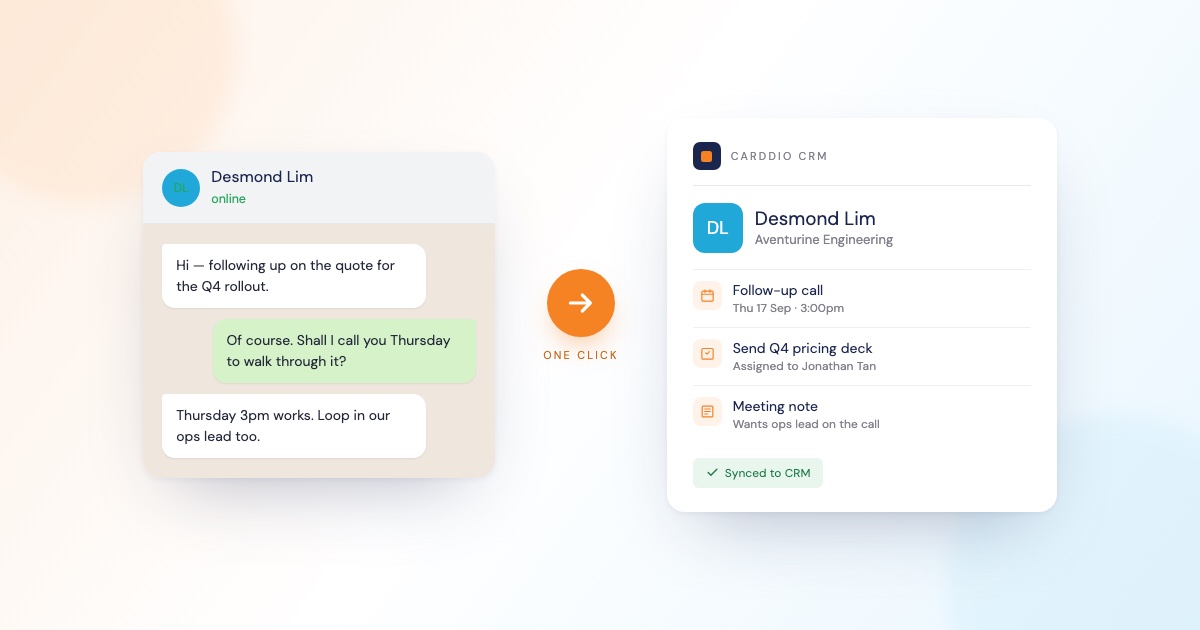
That is what CRM automation triggers are for. Set up a rule once: when a contact is added to an event, send the same-day email automatically, by email or WhatsApp. Your team writes the context line at the booth; the follow-up goes out on time without anyone remembering to send it. A second rule handles the day-five nudge for anyone who has not replied.
Frequently asked questions
Within 24 hours for anyone who showed real interest. Response rates drop sharply after the first few days, as the conversation fades and you start to read as cold outreach.
Two is usually right: one prompt follow-up and one nudge five to seven days later. Beyond that, move them to a longer-term nurture rather than continuing to chase.
Match the tone of the conversation. Formal introductions suit email; if you swapped numbers and chatted casually, a short WhatsApp message often gets a faster reply.
That is the problem to fix next time. Add one line of context to each contact at the event itself. For now, reference the event and ask an open question about their work rather than pretending to remember.
Turn your next event into replies
The difference between a networking event that produces pipeline and one that produces a stack of cards is almost entirely what happens in the next 24 hours.
See how Carddio’s automation triggers send follow-ups for you, or book a demo before your next event.